

Basic strategy is the first thing to learn if you want to play blackjack well. What You Will Learn Basic strategy is the fundamental way to play every…
Blackjack Terms for Beginners: From Hit and Split to House Edge

Blackjack uses many terms that rarely come up in other games. You can enjoy the game without knowing them, but articles that explain strategy, such as basic strategy, are hard to follow if you do not know what the terms mean.
You do not need to memorize them all. If you are in the middle of a game and cannot remember what a term means, come back to this page and look for the relevant heading.
What You Will Learn
- Blackjack terms fall roughly into five categories.
- Knowing the basic terms makes basic strategy easier to understand.

This article takes about 10 minutes to read.
Contents
Show
Basic Terms Used in Blackjack
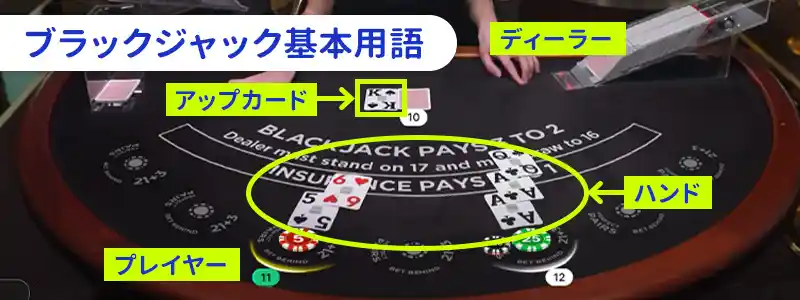
This section covers the terms that form the foundation of the game: player, dealer, hand and upcard. Our blackjack pages use them without explanation, so it helps to learn them first.
Player
A player is anyone taking part in a game of blackjack. Live blackjack tables usually have seven seats, but some tables, such as Infinite Blackjack, have no limit on the number of players.
Dealer
The dealer is the casino employee who runs the game at the table. In blackjack, the dealer deals the cards to the players and to themselves and is also the players’ opponent. A player wins by beating the dealer’s total or having the dealer bust (go over 21), a term explained later.
Hand / Multi-Hand
A hand is the set of cards a player holds. Normally each player plays from one seat, but if the table has empty seats, one player can play two or more hands at the same time. This is called multi-hand play. Playing more hands does not change the house edge on each hand, but because your total stake goes up, your theoretical loss grows as well.
Upcard
The upcard is the first card dealt to the dealer. In blackjack, the players and the dealer each receive two cards. The player’s two cards are dealt face up, while the dealer receives one card face up and one face down, known as the hole card. The face-up card is the upcard.
Terms Used for Blackjack Actions and Betting
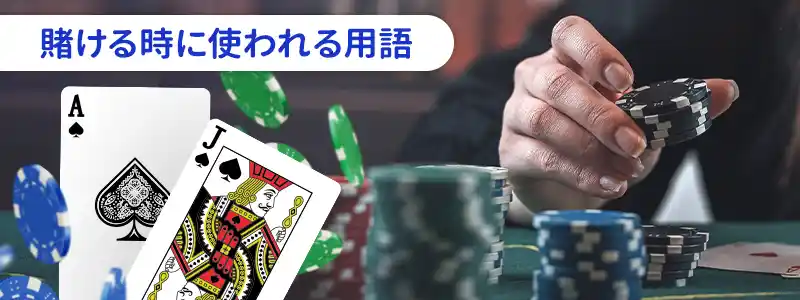
The decisions a player makes during a round are called actions.
Bet
A bet is the amount a player wagers, and the term also refers to the act of wagering itself. You place a bet by putting chips in the betting circle printed on the layout.
Deal
The deal is the distribution of cards to the players and the dealer. Once the deal is complete and your turn comes, you can begin to act. Some tables let you select your action before your turn arrives.
Hit
To hit means to draw another card. When your turn comes, you can ask for a hit to receive one more card. The dealer always hits on a total of 16 or less.
Stand / Stay
To stand means to keep your hand as it is without drawing any more cards. Standing is also called staying. The dealer stands on a total of 17 or more. At tables where the dealer hits soft 17 (H17), however, the dealer takes a card on a soft 17, that is, a 17 in which an ace counts as 11, such as A + 6. Soft hands are explained later.
Double Down
To double down means to double your bet on the condition that you receive only one more card.
Split
To split means to separate your first two cards into two hands, one card each, when they are of the same rank (the suits may differ). Each hand needs a bet equal to the original, so your total bet doubles. Some tables also allow you to split two 10-value cards (10, J, Q, K) of different ranks, since they all count as 10.
At some tables, if a card dealt to one of the new hands after a split is again of the same rank, you can split once more. This is called resplitting.
Surrender
To surrender means to give up the hand when you judge that it cannot beat the dealer. You concede the round, and half of your bet is returned. Surrender is not available once you have hit or split, and it is only correct in a limited number of situations under basic strategy.
Insurance
Insurance is a bet you can place when the dealer’s upcard is an ace. You bet half of your main bet as insurance, and if the dealer has a natural blackjack (21 on the first two cards, an ace and a 10-value card, explained later), the insurance bet pays 2 to 1. With a $10 main bet and a $5 insurance bet, for example, the insurance bet wins $10, which exactly offsets the $10 lost on the main bet, so you break even on the round. If the dealer does not have a natural blackjack, you lose the insurance bet and play continues.
On its own, however, the insurance bet has a clearly negative expected value of about −7.5% (8 decks), so as a rule, you should not take insurance. Insurance is covered in detail in the article linked below.
Even Money
Even money is an option available when the dealer’s upcard is an ace and your hand is a natural blackjack. If the dealer also has a natural blackjack, the hand would be a push, but by taking even money you are guaranteed a 1 to 1 payout regardless of the dealer’s hand, so a $10 bet wins $10. No additional bet is required.
However, a natural blackjack normally pays 3 to 2, so a $10 bet would win $15. Even money trades part of your payout for certainty, and over the long run it lowers your expected value compared with declining it. As with insurance, you should not take even money as a rule.
Side Bet
A side bet is a bet settled on a condition separate from the outcome of the main hand (the player’s hand against the dealer’s). Unlike the main bet, in which the player competes against the dealer, a side bet is placed on outcomes such as the combination of cards dealt or the card on which the dealer busts. With a “Pair” side bet, for example, the bet wins if the player’s first two cards are of the same rank. Side bets have a higher house edge than the main bet, so it is safest to keep both your stakes and the number of side bets small. Side bets are covered in detail in the article below.
Table Limit / Maximum Bet
The table limit (maximum bet) is the most you can wager on a single bet. Live blackjack generally has higher limits than RNG blackjack (blackjack played against a computer), and main bets have higher limits than side bets.
The bet limit applies only to the initial bet. Doubling down or splitting adds an amount equal to the original bet, so the total you can put in during a single round can be several times the stated limit.
Blackjack Card Terms
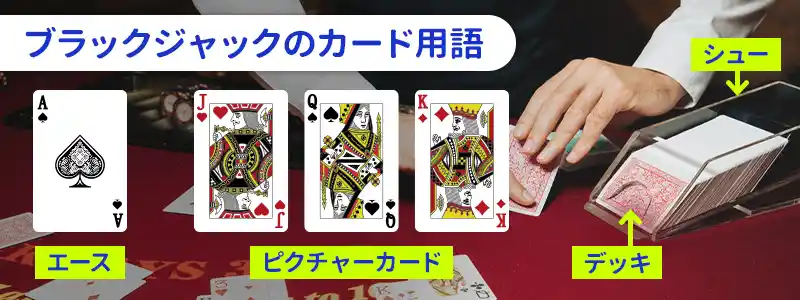
Most terms related to the cards are easy to remember because other table games use the same words.
Deck
A deck is a set of 52 playing cards with the jokers removed. A “6-deck” game, for example, uses six of these sets.
Most blackjack games shuffle 6–8 decks together and place them in a single shoe. In a 6-deck game, for example, each card of a given rank and suit, such as the A♠, appears six times.
Shoe
The shoe is the card holder used in blackjack. At a 6-deck table, for example, all six decks are shuffled together and placed in the shoe.
The dealer draws the cards from the shoe one at a time. In card counting, explained later, a player keeps track of the cards dealt so far and can therefore work out which cards remain in the shoe.
Ace
The ace is the card marked “A.” In blackjack, an ace can count as either 1 or 11, so a hand that counts an ace as 11 (a soft hand) cannot bust by drawing one more card. For this reason, the ace leaves more room for decisions.
Picture Card / Face Card
Face cards, also called picture cards, are the three cards with pictures on them: the J, Q and K. In blackjack they all count as 10. Together with the 10s, these 10-value cards make up 16 cards per deck, more than any other value.
Terms Used for Blackjack Outcomes
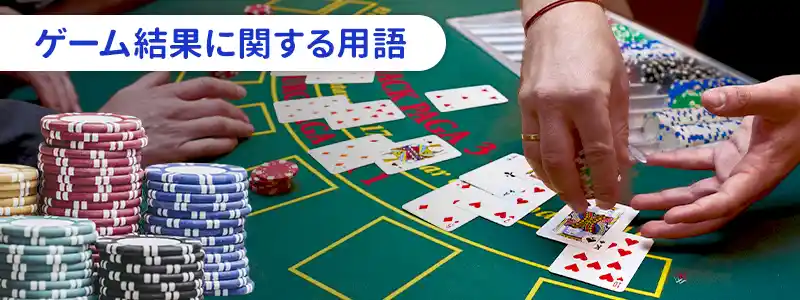
Dealers use the terms in this section constantly and without explanation, so they are worth learning.
Push
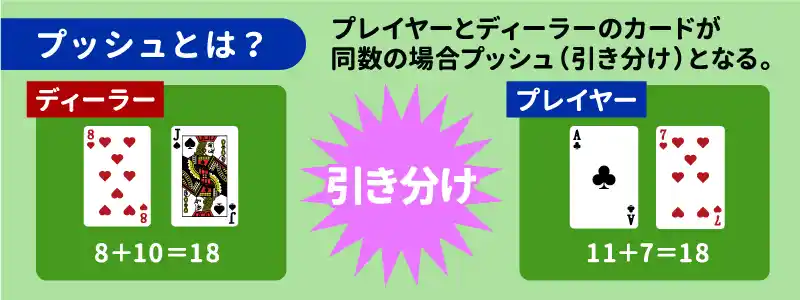
A push is a tie between the player and the dealer.
Apart from the rule that a natural blackjack beats a 21 made with three or more cards, the outcome in blackjack is decided by the totals alone. If the player and the dealer have the same total, the hand is a push.
Bust
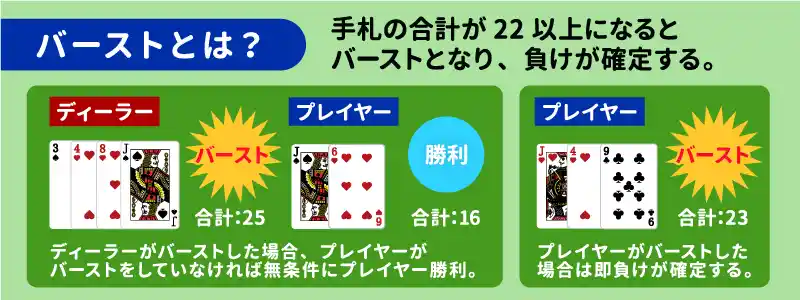
To bust means to go over 21, that is, to reach a hand total of 22 or more. If you bust, you lose no matter what the dealer’s total is. If the dealer busts, every player who has not busted wins.
For this reason, blackjack is not only about getting close to 21. When the dealer looks likely to bust, standing and waiting to see what the dealer draws is also an effective play.
Pair / Any Pair
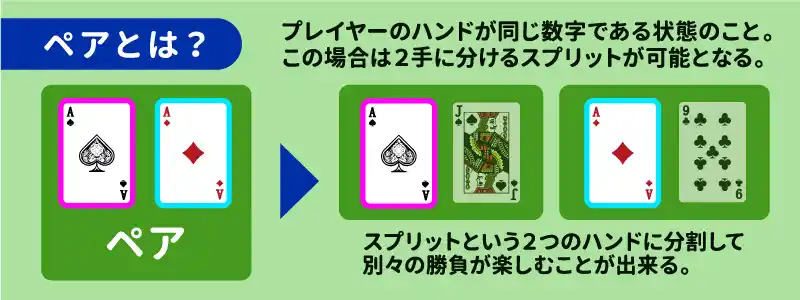
A pair is a hand made up of two cards of the same rank. You can split a pair, and if you placed a “Pair” side bet, that bet pays out. Any two 10-value cards are treated as having the same value, so they can be split, but if their ranks differ, they do not count as a pair for the side bet.
Any pair is a side bet term for a pair that wins whether or not the two cards share the same suit. A pair whose cards also match in suit is called a “perfect pair.”
Blackjack / Natural Blackjack
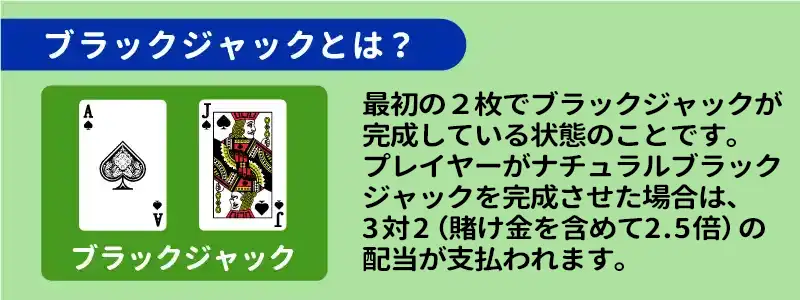
A blackjack, or natural blackjack, is a hand that totals 21 with the first two cards. It consists of an ace and a 10-value card, such as Q♦ + A♣. A natural blackjack beats a 21 made with three or more cards, so a natural against an ordinary 21 is not a push.
When a player has a natural blackjack, it pays 3 to 2. If you bet $10 and get a natural blackjack, for example, you win $15 and receive $25 in total, including your $10 bet, unless the dealer also has a natural blackjack.
Terms Used in Blackjack Strategy
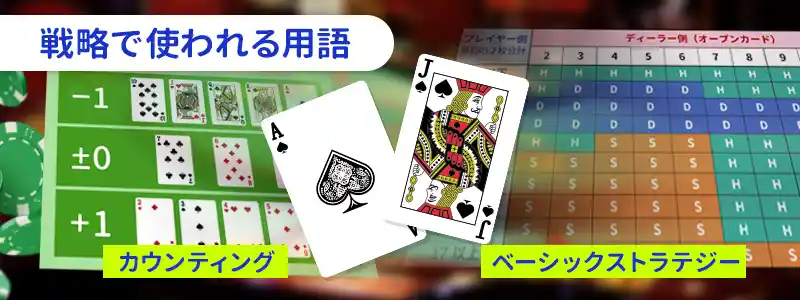
In blackjack, the player’s decisions have a large effect on the result, and the more closely you follow the correct play, the closer your return to player (RTP) comes to the theoretical figure. Knowing the terms in this section makes it easier to avoid unnecessary losses.
House Edge / Return to Player
The house edge is the percentage of the total amount wagered that the casino is expected to keep over the long run. Its counterpart is RTP, the theoretical percentage of wagers that is paid back to players. The house edge and RTP always add up to 100%.
In blackjack with standard rules, a player who follows basic strategy faces a house edge of about 0.5%, which corresponds to an RTP of around 99.5%. Both are long-term theoretical figures and do not indicate how easy it is to win.
Basic Strategy
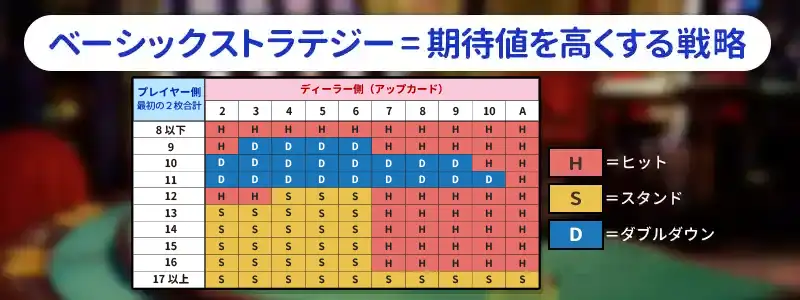
Basic strategy is a way of playing that tells you whether to hit, stand, double down, split and so on in each situation. In every case, it points to the action that keeps your losses as low as possible. The correct action depends on the combination of your hand and the dealer’s upcard, and a table that sets out these decisions is called a strategy chart.
By following a strategy chart, you can choose the action with the highest expected value in every situation. Even with perfect basic strategy, however, a house edge of about 0.5% remains. Basic strategy is not a way to win; it is a way to keep the house edge as low as possible.
- Related Article
-
Soft Hand / Soft Total
A soft hand, also called a soft total, is a hand in which an ace can be counted as 11. Because an ace counts as either 1 or 11, the hand has two possible totals, which gives you more freedom to choose an action without worrying about busting.
A hand such as A + 5 + 8, in which the ace must count as 1, is a hard hand.
Hard Hand / Hard Total
A hard hand, also called a hard total, is a hand that contains no ace, or in which an ace can only count as 1 because counting it as 11 would bust the hand. With hard hands, the dealer’s upcard matters most, and you need to choose carefully between hitting, standing, doubling down and the other actions.
Card Counting
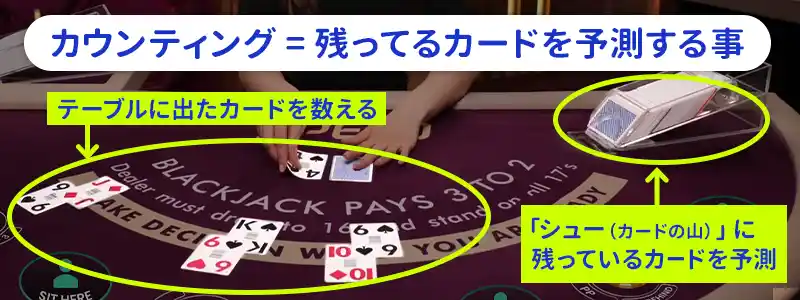
Card counting is a technique in which a player keeps track of the cards dealt so far in order to work out how many cards of each value remain in the shoe.
When many 10-value cards and aces remain in the shoe, the dealer is more likely to bust on a hand of 12–16, and a player who doubles down on 10 or 11 is more likely to succeed. Together, these two effects reduce the house edge. The idea is to recognize favorable and unfavorable situations and use that information to decide how much to bet and which action to take.
However, card counting has no effect in RNG games, which shuffle after every hand, or at tables that use a continuous shuffling machine. Many live blackjack tables at online casinos also reshuffle early in the shoe, so the situations in which counting gives a practical edge are limited.
- Related Article
-
Summary: Knowing the Terms Helps You Understand the Rules and the House Edge
Blackjack has more terms of its own than most other table games, so you may not remember many of them at first.
Once you understand the terms, though, you can read strategy charts and the rules shown at the table, which makes it easier to make decisions that keep the house edge as low as possible. To start with, it is enough to know the actions you will use yourself (hit, stand, double down and split) and what the house edge means.
This site is for adults of legal gambling age (18+, or older where required) who live in countries or regions where online gambling is legal.
Use of this site is subject to our Terms and Conditions.
Gambling involves risk. Only bet what you can afford to lose, and do not use online gambling services where they are illegal.

Bell | Editor of Online Casino Winners Club. Since the site launched in 2003, Bell has written guides to casino game rules, tested betting systems and covered land-based casinos around the world, and still plays the games before writing about them. Bell's core advice: choose the bets with the lowest house edge, and decide in advance how much you are prepared to lose.